Affiliate links: if you buy through links on this page we may earn a commission, at no extra cost to you.
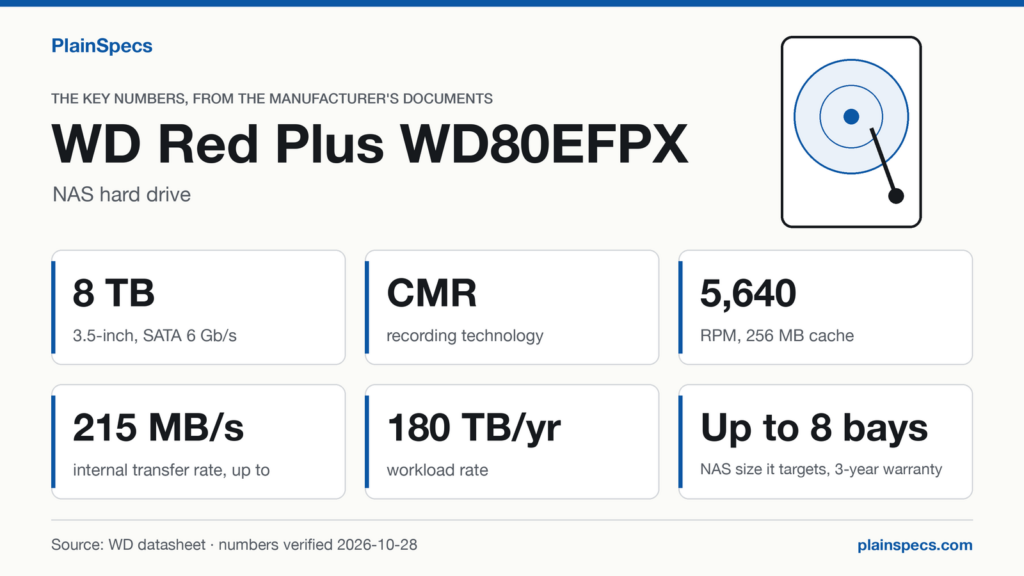
WD Red Plus WD80EFPX: the key numbers, verified
Verified against the manufacturer datasheet WD Red Plus product brief, March 2025 (opens in a new tab) on .
Every figure below comes from the WD80EFPX column of WD’s Red Plus specifications table, or from the brief’s first page, which covers the whole range.
| Spec | Value | Source |
|---|---|---|
| Model number | WD80EFPX | WD brief, p. 2 |
| Drive class | NAS hard drives | WD brief, p. 1 |
| Formatted capacity | 8TB | WD brief, p. 2 |
| Form factor | 3.5-inch | WD brief, p. 2 |
| Interface | SATA 6 Gb/s | WD brief, p. 2 |
| Recording technology | CMR | WD brief, p. 2 |
| Drive technology | Air | WD brief, p. 2 |
| Rotational speed | 5640 RPM | WD brief, p. 2 |
| Cache | 256MB | WD brief, p. 2 |
| Internal transfer rate, up to | 215MB/s | WD brief, p. 2 |
| Workload rate | 180TB/year | WD brief, p. 2 |
| MTBF | 1,000,000 hours, at a 90TB/year workload and 40°C drive temperature | WD brief, p. 2 (note 9) |
| Non-recoverable errors per bits read | <1 in 1014 | WD brief, p. 2 |
| Load/unload cycles | 600,000 | WD brief, p. 2 |
| Limited warranty | 3 years (terms vary by region) | WD brief, p. 2 |
| NAS size WD states it for | RAID-optimized NAS systems with up to 8 bays | WD brief, p. 1 |
| Average power: read/write, idle, standby and sleep | 5.2 W, 3.4 W, 0.4 W | WD brief, p. 2 |
| Acoustics: idle, seek (average) | 24 dBA, 28 dBA | WD brief, p. 2 |
| Operating temperature | 0 to 65°C | WD brief, p. 2 |
| Weight | 715 g (± 10%) | WD brief, p. 2 |
| WD technologies named | NASware, dual-plane balance control | WD brief, p. 1 |
If these numbers fit your NAS, this is where to find the WD Red Plus WD80EFPX.
View the WD Red Plus WD80EFPX on Amazon (opens in a new tab)
What the numbers mean
Capacity: 8TB on the label, about 7.28 TiB in your NAS
The datasheet states a formatted capacity of 8TB, and its footnote counts 1TB as one trillion bytes. An operating system or NAS dashboard that counts in binary units, where 1 TiB is 1,099,511,627,776 bytes, reports the same drive as about 7.28 TiB (8,000,000,000,000 ÷ 1,099,511,627,776). Nothing is missing: same bytes, counted two ways.
Usable space in a RAID array
WD states the drive for NAS systems with up to 8 bays, so the practical question is what a set of them gives you. RAID 1 and RAID 5 give up one drive’s worth of space to redundancy, RAID 6 two drives’ worth. With 8TB drives the arithmetic is:
| Layout | Drives | Usable space, before file system overhead |
|---|---|---|
| RAID 1 (mirror) | 2 | 8TB (1 × 8TB) |
| RAID 5 | 4 | 24TB (3 × 8TB) |
| RAID 6 | 8 | 48TB (6 × 8TB) |
Speed: about 10.3 hours for one full pass
The datasheet states 5640 RPM and an internal transfer rate of up to 215MB/s, counting 1MB/s as one million bytes per second. At that rate the drive moves about 774GB an hour (215MB × 3,600 seconds), and one pass over all 8TB takes at least 10.3 hours (8,000,000MB ÷ 215MB/s ≈ 37,200 seconds). That is the floor for any job that touches every sector once: copying a full drive, a full data scrub, or writing a replacement drive during a RAID rebuild. Since 215MB/s is an “up to” maximum, a real full pass takes longer.
Interface: SATA 6 Gb/s has room to spare
The datasheet states a 3.5-inch drive on SATA 6 Gb/s. In bits, its 215MB/s maximum is 1.72 Gb/s (215 × 8 = 1,720 Mb/s), under a third of the 6 Gb/s link: the drive, not the link, sets the speed. WD lists the drive technology as Air.
Recording: CMR, from WD’s own table
The datasheet lists the recording technology as CMR (conventional magnetic recording), which settles the “CMR or SMR” question for this model from WD’s own specifications table.
Cache: 256MB, and why the model number matters
The datasheet states 256MB of cache. WD’s Red Plus table has two models of this capacity: the WD80EFPX and the WD80EFZZ, each with its own column and with different figures for cache, transfer rate, power, noise and weight. The WD80EFBX doesn’t appear in WD’s March 2025 brief, nor on WD’s US and UK product pages as of 2026-10-28, so WD gives no figures for it to compare. If a product page says “WD Red Plus 8TB” without a model number, this page may not describe the drive it sells: look for WD80EFPX.
Workload: 180TB a year is about 493GB a day
The datasheet rates the drive for 180TB a year of workload, and its footnote counts data transferred both to and from the drive, so reads count as well as writes. That is about 493GB a day (180TB ÷ 365), or 22.5 passes over the full 8TB a year (180 ÷ 8). Scheduled maintenance uses this budget too: a monthly full scrub of a full drive reads 96TB a year (12 × 8TB), more than half the rating before any of your own files move. The rating is per drive.
MTBF: 1,000,000 hours at half the rated workload
The datasheet states an MTBF of 1,000,000 hours, under a 90TB/year workload and a 40°C drive temperature. The test load is half the 180TB/year rating (90 ÷ 180), so the figure describes a drive at half its rated load, not a busier or hotter one. MTBF describes a large group of drives, not the lifespan of yours. As a rough conversion, a year of 24/7 operation is 8,760 hours, and 8,760 ÷ 1,000,000 is 0.876%: an annualized failure rate a little under 1 in 100, under WD’s test conditions.
Read errors: fewer than 1 in 1014 bits
The datasheet states fewer than 1 non-recoverable error per 1014 bits read. That many bits is 12.5TB (1014 ÷ 8 bits per byte = 12.5 trillion bytes), so one full read of this 8TB drive covers 64% of that span (8 ÷ 12.5). The figure is a ceiling, not a forecast, but it matters for single-parity arrays: rebuilding a four-drive RAID 5 of these drives reads the three survivors end to end, 24TB, almost twice 12.5TB. One more reason to keep a backup outside the array.
Load/unload cycles: about 548 head parks a day
The datasheet rates the drive for 600,000 load/unload cycles, the times the heads park and return to the platters. Spread across the 3-year limited warranty, that is about 548 a day (600,000 ÷ 1,095 days), or about 23 an hour. Aggressive power saving spends this budget: parking once every five minutes, around the clock, uses 288 a day (1,440 minutes ÷ 5).
Power: about 30kWh a year per idle drive
The datasheet lists average power of 5.2 W in read/write, 3.4 W at idle and 0.4 W in standby and sleep. A drive idling around the clock uses about 29.8kWh a year (3.4 W × 8,760 hours = 29,784Wh); spun down, about 3.5kWh (0.4 W × 8,760 hours). In a full 8-bay NAS, the drives alone draw about 41.6 W in read/write (8 × 5.2 W) and 27.2 W at idle (8 × 3.4 W), before the NAS itself: the drive share to count when sizing a UPS.
Noise: 24 dBA idle, 28 dBA seeking
The datasheet lists acoustics of 24 dBA at idle and 28 dBA in seek (average). The drive is 4 dBA louder when busy finding data than when only spinning. WD doesn’t state how or from what distance it measured, so these figures compare drives within WD’s own brief, not against other brands’ numbers.
Temperature: 0 to 65°C operating
The datasheet lists an operating range of 0 to 65°C, while the MTBF figure assumes 40°C, 25°C below the top of that range (65 − 40). A NAS that keeps its drives at or below 40°C stays within the temperature WD quotes for its MTBF figure, not just the range it allows; WD notes that MTBF is derated above its test conditions.
Up to 8 bays: WD’s stated use, not a hardware limit
WD states the drive is “for RAID-optimized NAS systems with up to 8 bays”. That is intended use, not a technical limit WD publishes: in a 12-bay chassis the drive is outside the use WD rates it for. WD also says its NASware technology tunes drive parameters to NAS workloads and its dual-plane balance control improves balance: WD’s descriptions, not measured figures.
Warranty and weight
The datasheet lists a 3-year limited warranty, with terms that vary by region. Each drive weighs 715 g (± 10%), so four of them add about 2.86 kg (4 × 715 g) to a NAS.
What it can and can’t do
It can
- Go in a NAS with up to 8 bays, the range WD states for it.
- Connect over SATA at 6 Gb/s in a 3.5-inch bay.
- Run within WD’s rating at up to 180TB of data transferred per year.
It can’t
- Stay within WD’s stated use in a NAS with more than 8 bays.
- Stay within WD’s rating with workloads above 180TB per year.
What to buy with it
WD Red Plus WD80EFPX: Where to buy the WD80EFPX (opens in a new tab)
Check that the model number is exactly WD80EFPX, and for an array buy the number of drives your layout needs (see “Usable space in a RAID array”).
Changelog
- : First published.
- : Added a key-numbers card as the featured image.
Edited by Stefano Mastria. Verified against manufacturer datasheet March 2025 on .