Affiliate links: if you buy through links on this page we may earn a commission, at no extra cost to you.
WD80EFPX vs WD80EFZZ: the numbers side by side, verified
WD80EFPX figures verified against the manufacturer datasheet WD Red Plus product brief, March 2025 (opens in a new tab) on . WD80EFZZ figures verified against the manufacturer datasheet WD Red Plus data sheet, September 2025 (opens in a new tab) on .
The short answer: both are 8TB CMR NAS drives at 5640 RPM, with the same workload rating, MTBF and warranty. WD’s columns differ in seven rows, highlighted at the top of the table: the WD80EFPX lists twice the cache and the higher transfer rate, the WD80EFZZ the higher power, noise and weight figures.
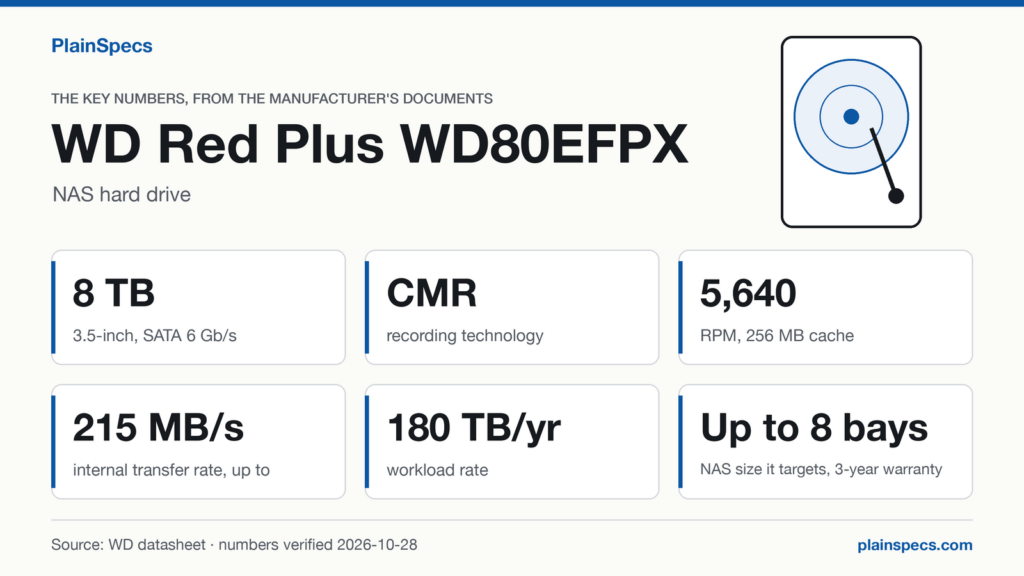
| Spec | WD80EFPX | WD80EFZZ | Gap |
|---|---|---|---|
| Cache | 256MB | 128MB | Twice as much on the WD80EFPX |
| Internal transfer rate, up to | 215MB/s | 185MB/s | 30MB/s, about 16% more on the WD80EFPX |
| Average power, read/write | 5.2 W | 6.2 W | 1.0 W, about 19% more on the WD80EFZZ |
| Average power, idle | 3.4 W | 4.1 W | 0.7 W, about 21% more on the WD80EFZZ |
| Acoustics, idle | 24 dBA | 25 dBA | 1 dBA |
| Acoustics, seek (average) | 28 dBA | 30 dBA | 2 dBA |
| Weight | 715 g (± 10%) | 750 g (± 10%) | 35 g |
| Formatted capacity | 8TB | 8TB | Same |
| Form factor, interface | 3.5-inch, SATA 6 Gb/s | 3.5-inch, SATA 6 Gb/s | Same |
| Recording, drive technology | CMR, Air | CMR, Air | Same |
| Rotational speed | 5640 RPM | 5640 RPM | Same |
| Workload rate | 180TB/year | 180TB/year | Same |
| MTBF | 1,000,000 hours, at 90TB/year and 40°C | 1,000,000 hours, at 90TB/year and 40°C | Same |
| Non-recoverable errors per bits read | <1 in 1014 | <1 in 1014 | Same |
| Load/unload cycles | 600,000 | 600,000 | Same |
| Average power, standby and sleep | 0.4 W | 0.4 W | Same |
| Operating temperature | 0 to 65°C | 0 to 65°C | Same |
| NAS size WD states it for | Up to 8 bays | Up to 8 bays | Same |
| Limited warranty | 3 years | 3 years | Same |
If the WD80EFPX column fits your NAS, this is where to find the WD Red Plus WD80EFPX.
View the WD Red Plus WD80EFPX on Amazon (opens in a new tab)
What the differences mean
Speed: about 1 hour 41 minutes per full pass
WD states up to 215MB/s for the WD80EFPX and 185MB/s for the WD80EFZZ. Counting 1MB as one million bytes, one pass over all 8TB takes at least 10.3 hours on the WD80EFPX (8,000,000MB ÷ 215MB/s) and 12.0 hours on the WD80EFZZ (8,000,000MB ÷ 185MB/s): about 1 hour 41 minutes more. That applies to any job that touches each sector once: a full scrub, a full-drive copy, a RAID rebuild. Both are “up to” maximums, so real passes take longer.
When the speed gap doesn’t show: a 1 Gb/s port
A 1 Gb/s Ethernet port carries at most 125MB/s (1,000 Mb/s ÷ 8), below both maximums, so a large copy over that port is capped by the network with either drive. The 30MB/s gap shows on jobs inside the NAS, like scrubs and rebuilds, and on faster ports.
Cache: 256MB against 128MB
WD gives no speed figure for the cache, so the row mainly tells the two apart. A product page that says “WD Red Plus 8TB” without a model number could be either drive: the model number on the label decides which column applies.
Power: 0.7 W at idle is about 6.1kWh a year per drive
Idling around the clock (8,760 hours a year), one WD80EFPX at 3.4 W uses about 29.8kWh and one WD80EFZZ at 4.1 W about 35.9kWh: 6.1kWh apart (0.7 W × 8,760 hours = 6,132Wh). In a full 8-bay NAS, the most WD states for either drive, the drives draw 41.6 W against 49.6 W in read/write (8 × 5.2 W and 8 × 6.2 W), and the idle gap grows to about 49.1kWh a year (8 × 6,132Wh). One full pass at the rated maximum takes about 74Wh on the WD80EFZZ against about 54Wh on the WD80EFPX (12.0 hours × 6.2 W and 10.3 hours × 5.2 W).
Noise: 1 to 2 dBA
WD lists 24 and 28 dBA (idle, seek) for the WD80EFPX, 25 and 30 dBA for the WD80EFZZ. WD doesn’t state how or from what distance it measured, so the figures compare the two drives with each other, not with other brands.
Weight: 35 g, inside WD’s tolerance
The 35 g gap is smaller than WD’s ± 10% tolerance on either drive (10% of 715 g is 71.5 g), so weighing a drive can’t tell you which model it is.
What doesn’t differ, and mixing the two
Workload rating, MTBF, load/unload cycles, warranty and bay limit match row for row. If another spec page shows a different RPM, WD’s own tables list 5640 RPM for both. In a mixed array, a scrub finishes when the slowest drive does, so plan around the WD80EFZZ’s 185MB/s.
Pick the WD80EFPX if, pick the WD80EFZZ if
Pick the WD80EFPX if
- Scrubs, rebuilds and copies inside the NAS matter: about 1 hour 41 minutes less per full pass.
- The NAS runs around the clock with many drives: 0.7 W less per idle drive is about 49kWh a year across 8 bays.
- The NAS sits where you can hear it: 1 to 2 dBA lower in WD’s figures.
WD Red Plus WD80EFPX: Where to buy the WD80EFPX (opens in a new tab)
Pick the WD80EFZZ if
- You’re adding to an array of WD80EFZZ drives and want every member on the same model.
- The compatibility list for your exact NAS model names the WD80EFZZ and not the WD80EFPX.
- The NAS mostly serves files over a 1 Gb/s port, where the speed gap doesn’t show.
WD Red Plus WD80EFZZ: Where to buy the WD80EFZZ (opens in a new tab)
Either way, check that the model number is exactly the one you picked: WD makes both at 8TB.
Changelog
- : First published.
Edited by Stefano Mastria. Verified against WD’s Red Plus product brief (March 2025) on for the WD80EFPX, and WD’s Red Plus data sheet (September 2025) on for the WD80EFZZ.